How to Stop Pipes Freezing in Commercial Buildings This Winter
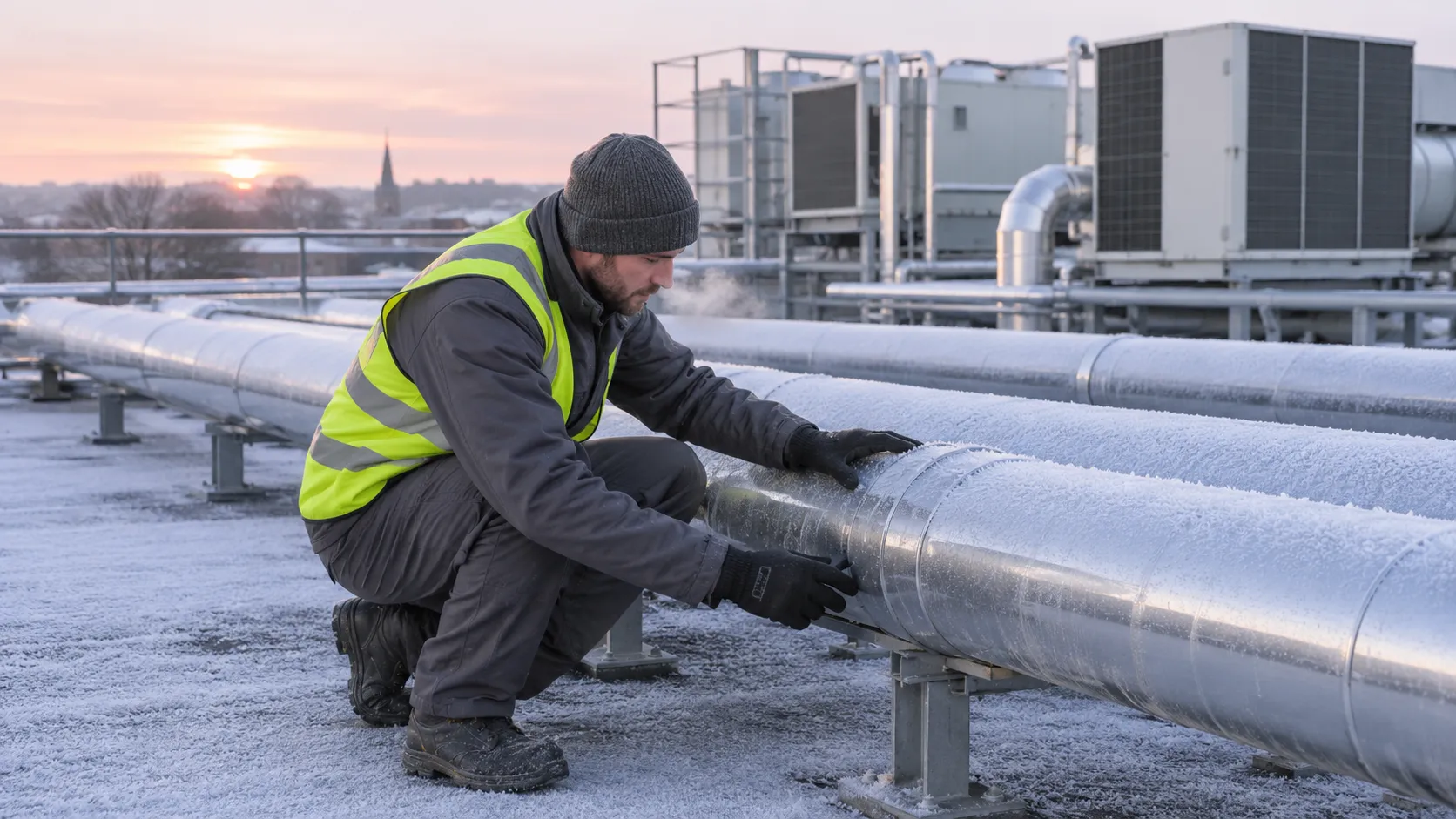
It only takes one hard frost. A pipe in an unheated plant room freezes overnight, splits, and nobody notices until it thaws on Monday morning. By then the water has been running for hours.
For facilities teams, frozen pipes are rarely about one pipe. They're about the building being shut at Christmas, a loading bay door left open, or a sprinkler main running through a car park that nobody thought about.
This guide covers why pipes freeze, which ones are most at risk and what actually stops it. There's a pre-winter checklist near the end you can hand straight to your site team.
In short: Pipes freeze when still water sits somewhere cold for long enough. Insulation slows heat loss, but it can't add heat. For pipes in spaces that drop below freezing for long spells, you need insulation plus frost protection trace heating, checked before the first cold snap.
Why pipes freeze
Water expands by about 9% when it turns to ice. Inside a pipe, there's nowhere for it to go. Pressure builds until a joint lets go or the pipe splits. The split often isn't where the ice is. It's further along, where water is trapped between the ice and a closed valve or tap.
Three things usually line up.
Cold spots
Plant rooms, roof spaces, risers on outside walls, under-croft car parks, loading bays and service voids. Any space that isn't heated, or loses its heat fast, can drop below zero even when the rest of the building is warm.
Still water
Moving water is much harder to freeze. Problems start when flow stops: overnight, at weekends, in dead legs and in pipes that only run when something calls for them, such as fire mains, standby lines and seasonal supplies.
Empty buildings
Heating gets turned down over Christmas. Offices close, schools break up and retail units sit empty between tenants. A frost setting may keep the occupied areas above zero, but not the void above the ceiling or the pipe running across the yard.
Which pipes are most at risk
- External pipework and anything running across a roof
- Pipes in unheated plant rooms, tank rooms and roof spaces
- Supplies to outside taps, wash-down points and vehicle wash bays
- Sprinkler and dry riser pipework in car parks and loading areas
- Cold water storage tanks and their feed pipes in lofts
- Condensate drains from air-conditioning units
- Dead legs and little-used branches
- Pipes near vents, louvres, roller shutters and doors that are often open
If one of your pipes is on that list and you don't know what's protecting it, it's worth checking.
Insulation vs trace heating: when you need which
This is where a lot of sites get caught out.
Pipe insulation slows down heat loss. It buys time. On a pipe with regular flow, or in a space that only dips below zero for a few hours, that's often enough.
But insulation doesn't create heat. If water sits still in a pipe at minus 5°C for long enough, it will freeze, however thick the lagging is. The insulation only changes how long that takes.
Trace heating adds heat. An electric heating cable runs along the pipe, under the insulation, and replaces the heat being lost. A thermostat switches it on as the temperature falls. It keeps the water above freezing for as long as the cold lasts.
|
Situation |
What usually works |
|---|---|
|
Heated building, pipe with regular flow |
Insulation on its own |
|
Unheated space, short cold spells, regular flow |
Insulation sized for frost protection |
|
External runs, long cold spells or still water |
Insulation plus frost protection trace heating |
|
Fire mains, standby lines and critical supplies |
Trace heating with alarms or monitoring |
|
Building empty for long periods |
Trace heating, or drain down unused services |
The two work as a pair. Trace heating without insulation over it wastes energy and may not keep up. Insulation without heat only delays the problem. Our frost protection service looks at both.
Not sure what's protecting your pipes? We'll check the site and show you where the gaps are. Book a frost protection survey.
A pre-winter checklist for facilities managers
Work through this before the first hard frost, and again before any long shutdown.
- List your at-risk pipes. Walk the site with the list above. Note every external run, plant room and void.
- Check the insulation. Look for missing sections, gaps at bends and valves, crushed or wet lagging and damaged cladding. Wet insulation protects very little.
- Check valves and fittings. Bare valves, strainers and flanges are common freeze points. Valve jackets and covers protect them without blocking access.
- Test the trace heating. Make sure every circuit powers up, the thermostats work and nobody has switched the controls off. Check for fault lights.
- Look at the building fabric. Broken louvres, gaps around pipes through walls and doors propped open all let cold air reach pipework.
- Plan for shutdown. Decide what stays on. Set the heating to protect voids and plant rooms, not just offices. Drain down services you won't need.
- Know where your stopcocks are. Label them. Make sure whoever is on call over Christmas knows too.
- Keep a record. Note what you checked and when. It helps with insurers and with next year's budget.
If you have trace heating that hasn't been tested for a while, read what trace heating is and how it works, or book trace heating testing and maintenance.
What to do if a pipe freezes
If water stops coming out of a tap, or you can see frost on a pipe, act before it thaws.
- Turn off the water supply to that section, or at the main stopcock.
- Open the taps fed by that pipe. This lets water out as it thaws and takes the pressure off.
- Warm the pipe slowly. Use warm air from a fan heater or hairdryer, or warm cloths. Start at the tap end and work back.
- Never use a naked flame. A blowtorch is a fire risk and can damage the pipe and the insulation.
- Check for splits before you turn the water back on. Watch the pipe and nearby joints as the supply comes back.
- Find the cause. A pipe that froze once will freeze again unless something changes.
If a pipe has already burst, shut off the water and make any nearby electrics safe first. Get the pipe repaired, then look at how to stop it happening again.
Book a frost protection survey
A frost protection survey looks at every at-risk pipe on your site. We check what's there, what's missing and what will work for each run, whether that's better insulation, trace heating or both. You get a clear list of priorities.
We work with facilities teams, landlords and contractors across London and the South East. To book a frost protection survey before the cold sets in, call 02033764802, email enquiries@icethermal.co.uk or get a quote today.
Related reading: frost protection, trace heating and pipework insulation.
You’re in good company. We’ve worked with the following commercial clients… View all














Why choose us?
- Cater to domestic, commercial and industrial facilities
- Nationwide coverage, available 24/7
- Free site survey provided prior to quotation
- Rapid response available
- A bespoke service designed to suit all your needs
- All operatives hold professional health and safety qualifications
We’re fully accredited
We take health and safety, our professional expertise and legal obligations very seriously. You can view a list of our accreditations below, or visit our Health & Safety page for more information.